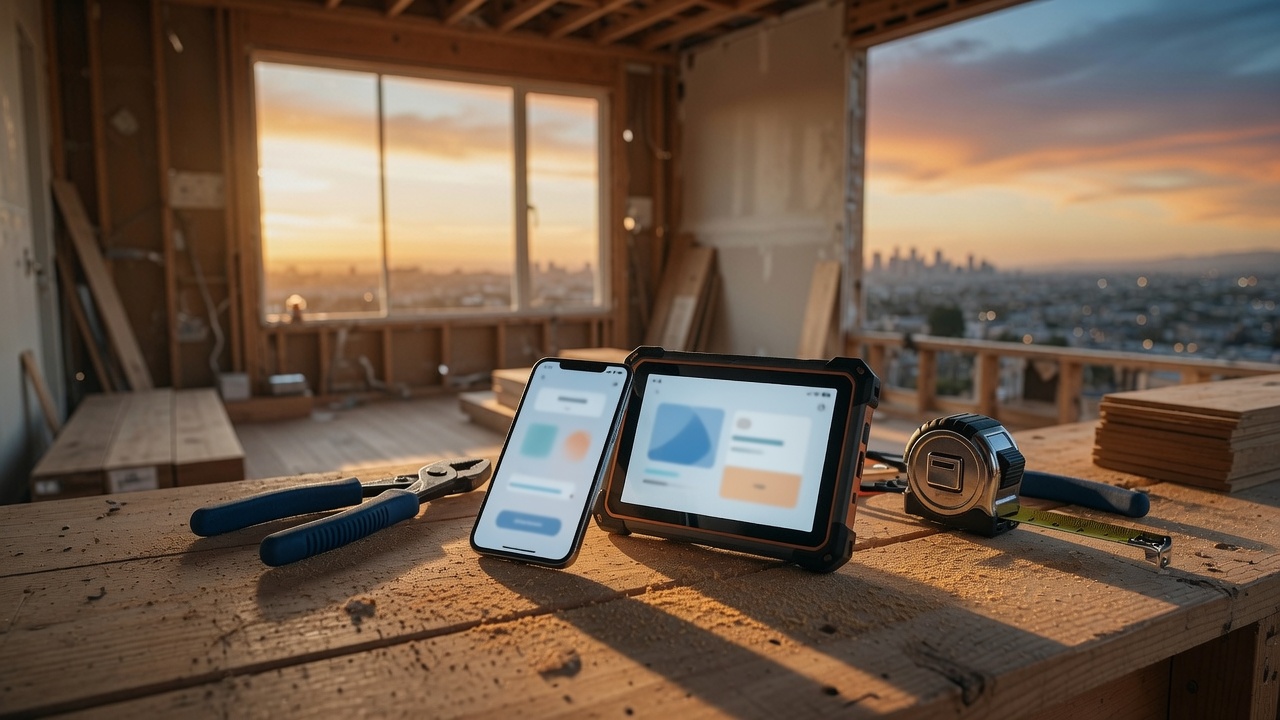

Let me walk you through a Tuesday night I've seen a hundred times.
It's 8:47 PM. You got home at 6:30 after a 10-hour day — two service calls, a panel rough-in, and a walkthrough for a kitchen remodel. You ate dinner standing at the counter. Now you're at the table with your laptop open, a price book from last quarter, and three estimates that need to go out before the homeowners call someone else.
The 200-amp panel upgrade takes the longest. You're counting breakers, sizing the feeder, cross-referencing conduit fill tables, looking up today's copper price (is it $4.50/lb or did it spike again?), and building the estimate line by line. An hour and a half later, you've got a PDF that may or may not reflect your actual costs.
Multiply that by five nights a week. That's your 15 hours.
The Real Cost of Manual Estimating
Every electrician knows that quoting takes too long. But most don't do the math on what those hours actually cost.
If your billable rate is $85/hour and you're spending 15 hours a week on admin instead of billable work, that's $1,275 per week in lost revenue. That's $66,000 a year — enough for another truck, another tool set, or an actual vacation.
And that's just the time cost. The accuracy cost is worse.
When you're quoting at 9 PM from memory, you make mistakes. You forget a junction box. You price #6 copper at last month's rate. You underestimate the labor on a tricky attic run because you're too tired to think it through. Each mistake is money out of your pocket on a job you already won.
Traditional electrical estimating software was supposed to fix this. Most of it didn't. Desktop-only applications that require you to sit at a computer, click through menus, and manually input every line item aren't saving time — they're just moving the paperwork to a different screen.
What Voice Quoting Actually Looks Like
Here's what the same Tuesday night looks like with voice quoting:
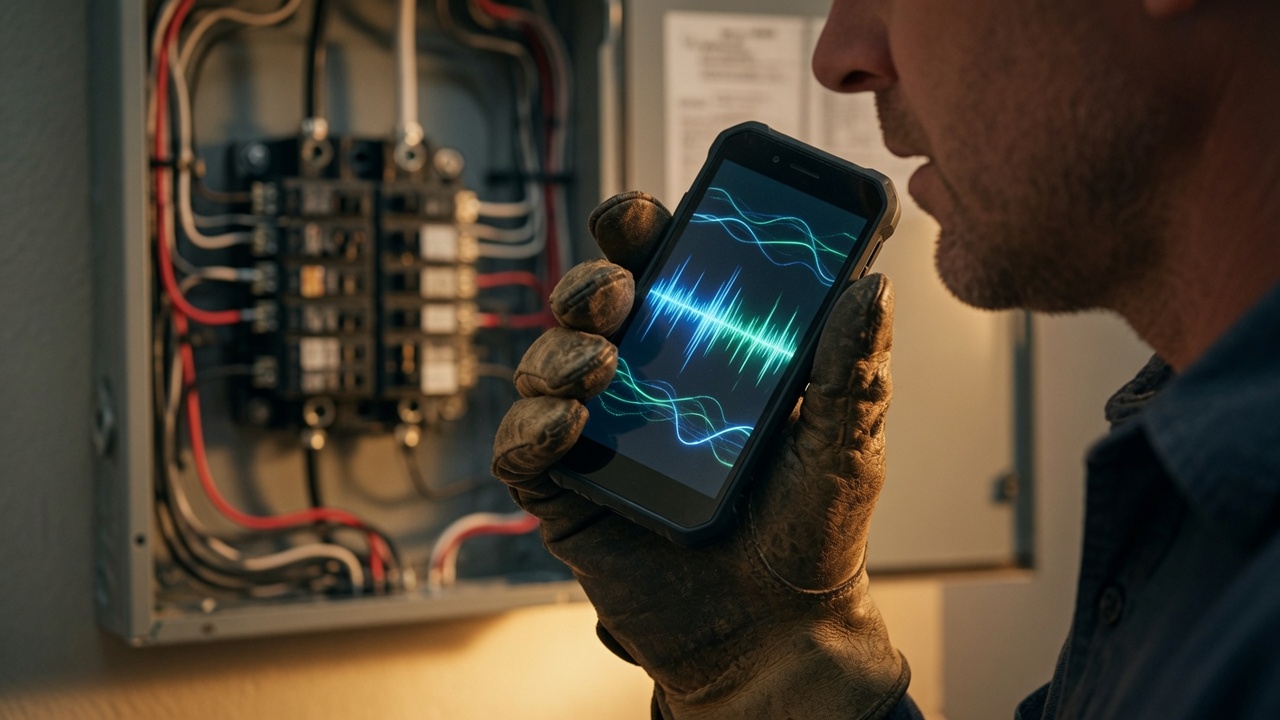
You're driving home from the walkthrough. You tap one button and say: "Quote a 200-amp panel upgrade for a single-family home. Square D QO, 42 spaces. 150 feet of 2/0 copper from the meter. New grounding electrode system. Pull the permit."
In under 30 seconds, you have a complete estimate on your phone. Materials priced at today's supplier rates. Labor calculated at your rates. Your markup applied. NEC 2023 compliance built in — conductor ampacity, conduit fill, voltage drop — all checked automatically.
You glance at it, adjust the labor hours on the underground run by 30 minutes, and hit send. The customer has a professional estimate in their inbox before you pull into your driveway.
That panel upgrade quote that used to take 90 minutes? Done in 3.
Why Voice-First Matters for Electricians
There's a reason voice works better than any electrical estimating software with a traditional interface. Electricians don't work at desks. You're in crawl spaces, attics, on ladders, standing in front of panels with your hands full.
Voice lets you build quotes the way you already think about jobs — in trade language, in real time, while you're looking at the work.
"Add a 20-amp dedicated circuit, 60 feet of 12/2 Romex, one GFCI outlet." You don't need to find that in a dropdown menu. You don't need to type it. You say it the way you'd tell your apprentice, and the software understands.
This isn't generic dictation. The AI behind voice quoting understands electrical terminology:
- Wire gauges and types: 14/2, 10/3, 2/0 THWN, MC cable, URD
- Panel specifications: Main lug, main breaker, number of spaces, brand
- NEC references: Ampacity tables, conduit fill calculations, voltage drop formulas
- Trade shorthand: "200-amp resi panel swap" means something specific, and the AI knows it
The Math: Before and After
Here's a conservative breakdown of time savings for a typical one-person electrical shop:
Before Voice Quoting
| Task | Time Per Week |
|---|---|
| Building estimates from scratch | 8 hours |
| Looking up material prices | 3 hours |
| Formatting and sending quotes | 2 hours |
| Revising quotes after site visits | 2 hours |
| Total admin time | 15 hours |
After Voice Quoting
| Task | Time Per Week |
|---|---|
| Voice-dictated estimates (avg 5 min each) | 2 hours |
| Quick review and adjustments | 1 hour |
| Auto-formatted, auto-sent quotes | 0 hours |
| Real-time revisions on-site | 0.5 hours |
| Total admin time | 3.5 hours |
Time saved: 11.5 hours per week. At $85/hour billable, that's $980/week recovered — or roughly $50,000 a year.
And that's before you factor in the accuracy improvements. When your quotes use today's material prices instead of last month's, when the NEC calculations are done correctly every time, and when your markup is applied consistently — your margins improve across the board.
What to Look for in Electrical Estimating Software
If you're evaluating electrical estimating software, here's what actually matters for a working electrician:
1. Works on your phone. If you have to be at a desk, it doesn't fit your workflow. Period.
2. Understands your trade. Generic contractor tools don't know the difference between a 200A panel upgrade and a service call. Your software should speak electrician.
3. Uses current pricing. A price book from last quarter is a liability, not an asset. Material costs change weekly — your estimates should reflect reality.
4. Handles code compliance. NEC 2023 has specific requirements for conductor sizing, GFCI protection, arc-fault protection, and more. Your estimating tool should know this so you don't have to double-check every quote.
5. Integrates with your business. Quotes should flow into invoices, invoices should sync with QuickBooks, and customer records should stay current — without you copying data between three different apps.
6. Works offline. Basements, mechanical rooms, and rural sites don't have Wi-Fi. Your tool needs to work without a connection and sync when you're back in range.
Stop Trading Evenings for Estimates
The electrical trade doesn't have a skills shortage — it has a tools shortage. The work itself hasn't fundamentally changed, but the business side is still stuck in spreadsheets and manual processes that eat your evenings and weekends.
Voice quoting isn't a gimmick or a novelty feature. It's a fundamental rethinking of how electrical estimating software should work — built around the way electricians actually operate, not the way software designers think they should.
Fifteen hours a week. That's the number. Every hour you get back is an hour you can bill, an hour with your family, or an hour of sleep you desperately need.
The estimates still go out. They just don't take all night anymore.