

Every generation of contractor software has tried to solve the same problem: get the business side of trades work done faster so you can focus on the actual work.
Spreadsheets replaced paper. Estimating software replaced spreadsheets. Mobile apps replaced desktop-only tools. Each step removed friction — but none of them solved the fundamental problem.
Contractors don't work at desks. They work with their hands. Every software tool that requires a keyboard, a mouse, or even sustained phone screen interaction is fighting the reality of how tradespeople actually operate.
Voice AI contractor software doesn't fight that reality. It works with it.
The Interface Problem Nobody Solved
Think about where you are when you need your software most:
- Standing in a customer's attic, flashlight in one hand, measuring tape in the other
- Driving between jobs, mentally planning the afternoon's work
- On a ladder, looking at a panel, calculating what the upgrade will cost
- In a crawl space, identifying a problem you need to quote before the homeowner decides to call someone else
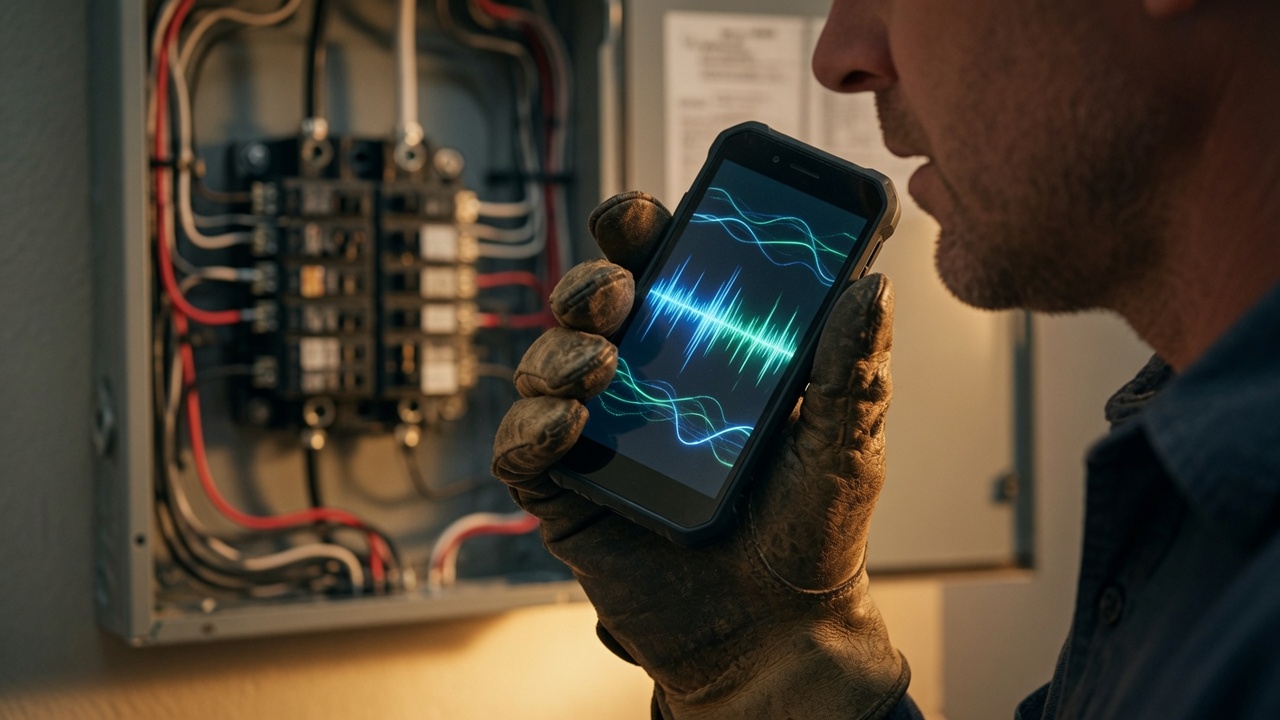
In every one of these situations, a keyboard is useless. A touch screen is awkward. But your voice works perfectly.
The trades industry has been waiting for an interface that matches the way tradespeople work. Voice AI is that interface. Not because it's new or trendy — because it's the first technology that lets you operate software without stopping what you're doing.
What Voice AI Actually Does (and Doesn't Do)
Let's be specific about what voice AI contractor software means in practice, because the term gets overloaded with hype.
What it does:
- Converts spoken descriptions of jobs into structured estimates with line items, pricing, and calculations
- Understands trade-specific terminology — wire gauges, pipe sizes, tonnage ratings, refrigerant types
- Handles multi-turn conversations: "Add a 50-gallon water heater to that quote. Actually, make it a 75."
- Works in noisy environments: job sites, trucks, supply houses
- Operates offline and syncs when connectivity returns
What it doesn't do:
- Replace your trade knowledge — it structures and calculates based on what you tell it
- Make decisions for you — it presents options and data; you decide
- Eliminate the need for site visits — you still need eyes on the work
- Work perfectly 100% of the time — it makes mistakes and needs correction, like any tool
The value isn't magic. It's time. Voice input is 3–5x faster than typing on a phone and 2–3x faster than navigating dropdown menus and form fields. For a contractor who builds 5–10 estimates per week, that time savings compounds into hours recovered every single week.
Why Now — What Changed
Voice recognition isn't new. Siri launched in 2011. Why is voice AI contractor software only becoming viable now?
Three things changed simultaneously:
1. Accuracy crossed the threshold
General-purpose voice recognition hit 95%+ word accuracy several years ago. But trade-specific vocabulary — "2/0 THWN," "three-quarter inch PEX-A," "16 SEER2 heat pump" — required specialized models. Large language models (LLMs) trained on technical content now understand trade terminology at near-human accuracy. That's a 2024–2026 development, not a 2020 one.
2. Context understanding arrived
Early voice tools were dictation — they transcribed words. Modern voice AI understands intent. When you say "quote a 200-amp panel upgrade," the system doesn't just transcribe those words. It knows that means: main breaker panel, likely Square D or Eaton, 30–42 spaces, 200A feeder, grounding electrode system, permit, and inspection. It asks clarifying questions if needed.
That's the difference between dictation and conversation. And conversation is what makes voice AI contractor software actually useful.
3. Mobile hardware caught up
Running an AI model that understands trade terminology in real time requires significant compute power. Modern smartphones can handle the initial voice processing locally (for offline capability) and hand off to cloud models for complex calculations when connected. Five years ago, this required cloud connectivity. Today, the basic pipeline runs on the phone in your pocket.
What This Means for Your Business
The practical implications for trade contractors are straightforward:
Faster quoting: Build estimates in the truck between jobs, not at the kitchen table at 9 PM. Voice input turns a 90-minute estimate into a 5-minute conversation.
More quotes sent: When quoting takes 5 minutes instead of 90, you quote more jobs. More quotes means more won work. The shop that sends the estimate first wins 60–70% of residential jobs.
Better accuracy: Voice AI paired with current pricing databases means your quotes use today's material costs, not last month's. No more stale price books eating your margins.
Field-first workflow: The estimate happens where the work is — on-site, while you're looking at the job. Not reconstructed from memory later that evening.
Reduced admin burden: If your biggest constraint is time, and the biggest time sink is admin work, voice AI removes the bottleneck. Fifteen hours of weekly admin becomes three. The rest is billable time, family time, or sleep.
The Inevitable Direction
Every tool in the trades has evolved toward matching how tradespeople actually work. Cordless tools replaced corded tools because cords limited where you could work. LED headlamps replaced flashlights because your hands were full. Mobile apps replaced desktop software because you're not at a desk.
Voice AI contractor software is the next step in that evolution. Not because it's impressive technology — but because contractors have always needed hands-free tools, and the technology finally caught up to the need.
The question isn't whether voice-first contractor tools will become standard. The question is whether you adopt them now — while they're a competitive advantage — or later, when they're table stakes.
Also see: How Voice Quoting Saves Electricians 15 Hours a Week | Introducing Pilot for Trades | Voice AI Features