

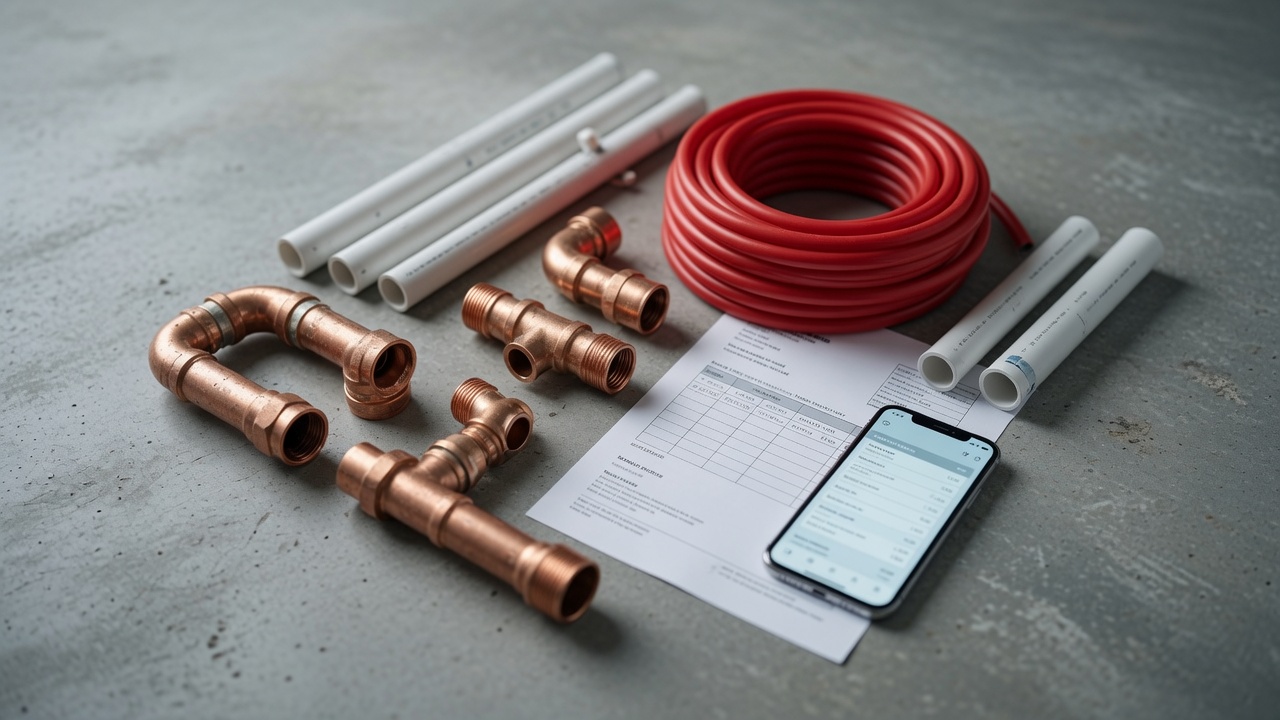
Last year, copper tubing prices moved 23% between January and July. PVC fittings saw a 12% swing in a single quarter. PEX-A tubing — the material half the industry switched to for stability — climbed 9% after a resin plant outage nobody saw coming.
If you quoted a whole-house repipe in March using January prices, you lost $400–$900 in materials before you cut a single pipe. That's not bad luck. That's a systems failure.
Plumbing material costs are volatile. Your estimates shouldn't be.
The Price Book Problem
Most plumbing contractors run estimates from a price book — either a printed sheet, a spreadsheet, or a file saved in their estimating software. That price book gets updated quarterly, maybe. Some shops update it once a year. Some never.
Here's the math on why that's dangerous:
A standard residential repipe — 2-bath, copper to PEX conversion — uses roughly $1,800–$2,500 in materials. If your price book is 60 days old and copper has moved 8%, you've underquoted materials by $150–$200. On a $5,000 job with 20% target margin, that's half your profit gone on materials alone.
Now multiply that across every job you quote in a month. If you're running 15–20 jobs, stale pricing can silently cost you $2,000–$4,000/month in margin erosion. That's $24,000–$48,000 per year. More than a truck payment. More than an apprentice's salary.
What Drives Plumbing Material Cost Swings
Understanding why prices move helps you protect against it:
Copper: Traded as a global commodity. Prices respond to mining output, Chinese demand, tariffs, and currency fluctuations. A single trade policy announcement can move copper 5% in a week. If your business relies on copper supply lines, DWV fittings, or water heaters with copper heat exchangers, you're exposed.
PVC and CPVC: Petrochemical derivatives. When oil and natural gas prices shift, PVC follows — usually with a 30–60 day lag. Factory shutdowns (hurricanes, plant maintenance) create sudden regional shortages that spike prices 15–20% overnight.
PEX tubing: Derived from high-density polyethylene (HDPE). More stable than copper, but still subject to resin supply disruptions. The 2025 resin plant fire in Texas caused a 9% jump that took four months to normalize.
Specialty items: Tankless water heaters, commercial mixing valves, backflow preventers — these follow manufacturer pricing cycles, not commodity markets. Annual price increases of 3–8% are standard, and they're not always announced loudly.
What Real-Time Pricing Looks Like in Practice
Real-time material pricing doesn't mean you're checking commodity futures every morning. It means your estimating tool does it for you.
When you build a quote — whether by typing, clicking, or dictating it by voice — every material line item reflects current supplier pricing. Not last month's. Not last quarter's. Today's.
Here's what that changes:
You quote with confidence. When a customer asks "is this estimate good?" you can honestly say yes — because it reflects the materials you'll actually buy, at the price you'll actually pay.
You protect your margins automatically. A 6% copper increase doesn't silently eat your profit. It shows up in the estimate before you send it, and you price accordingly.
You eliminate manual price checks. No more calling the supply house to verify prices on large quotes. No more opening four browser tabs to compare suppliers. The tool does it.
You can re-quote instantly. Customer waits two months to approve? Re-generate the estimate and materials reflect current costs. No manual recalculation required.
The Hidden Benefit: Winning More Work
Here's a counterintuitive advantage of real-time plumbing material costs in your estimates: you can actually bid more competitively without cutting your margin.
When your material prices are accurate, you're not padding estimates to cover "just in case the price went up." You're quoting the real number. On jobs where prices dropped, your bids are naturally lower — and more competitive — without any sacrifice to your margin.
Contractors using stale pricing tend to overbid some jobs (losing work they should have won) and underbid others (winning work that loses money). Accurate pricing eliminates both problems.
What to Look For
If you're evaluating tools to solve the plumbing material costs problem, here's what matters:
-
Supplier-integrated pricing: The tool should pull from actual distributor catalogs, not generic national averages. Your local supply house prices are what matter.
-
Automatic updates: Prices should refresh automatically — daily or weekly minimum. If you have to manually import a CSV, you won't do it consistently.
-
Material database breadth: It needs to know the difference between ½" copper Type L and ½" copper Type M. Generic "copper pipe" categories aren't useful for accurate estimating.
-
Works on your phone: You need to build and adjust quotes on the job site, not back at the office. If the tool is desktop-only, it doesn't fit a plumber's workflow.
-
Historical tracking: Being able to see how material costs have trended over 90 days helps you set expectations with customers and make smarter purchasing decisions.
Stop Guessing, Start Knowing
Plumbing material costs will keep moving. Copper doesn't care about your price book refresh schedule. PVC doesn't wait for your quarterly update.
The plumbers who protect their margins in a volatile material market aren't the ones who memorize prices. They're the ones whose tools know prices — automatically, accurately, in real time.
Your estimates should reflect reality. If they don't, the gap between what you quoted and what you spend is coming straight out of your pocket.
Also see: 5 Plumbing Estimating Mistakes That Cost You Thousands | For Plumbing Contractors